Saturday, 4 November 2017

Whodunit

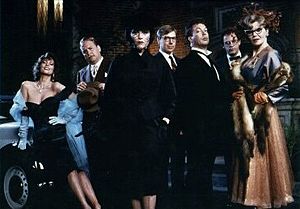
The Cast of "Clue"


Crime and mystery stories are very popular and with good reason. A lot of people like solving a puzzle and that is what every mystery story is deep in its heart. In a mystery or crime story, be it a cosy mystery, a police procedural, or a thriller (or anything and everything in between), the author sets up a puzzle and allows the reader to try and solve it next to the detective. This is why S. S. van Dine laid down the “Twenty Rules for Writing Detective Stories” a long time ago (I actually wrote a post about that already). I’m not going to rehash my previous post here, though. No, this is a post about a specific type of mystery story known as the Whodunit.

The Whodunit sets a few very specific rules for the author to remember. It can be done in different ways and there are a lot of good ones around for reading. Personally, I’d recommend “Murder on the Orient Express” or “Evil Under The Sun” for reading and “Clue” and “Death by Murder” for watching, even though the two movies are parodies of the genre rather than simple mystery stories (“Death by Murder” more so than “Clue”). Agatha Christie produced quite some Whodunits in her time (“Death on the Nile” or “And Then There Were None” also qualify as some). Edgar Wallace did quite some as well.

What, however, are the rules?
First of all, there’s limitation. Limits in space and in suspects. Usually, the Whodunit is set in a closed-off area. An old mansion in the countryside. A train stuck in a snowdrift. A house on an island. A ship in the middle of a river or ocean. This limit also means that there is no
‘outside’ perpetrator. There is no way a killer can have come and gone. One of those around must be the one who did it. Sometimes, there is a countdown of sorts (as in “And Then There Were None”). People are being killed and the survivors need to figure out who the murderer is before they’re all dead. Bringing people together for the reading of a will is a good way to bring about such a situation.
Then there’s a lot of reasons for killing the victim (or the victims). Everyone in that place (not just guests, often also personnel or inhabitants) has at least one reason to wish the murdered person ill. The detective might even not be above suspicion themselves. The Whodunit is a crime genre which works well with all kinds of possible detectives (professional, semi-professional, or amateur), because the locked-off premises give a good reason why the police can’t or won’t arrive there any time soon.

If you look at “Murder on the Orient Express,” probably the most prominent entry on my list, you will find all of this: the train is stuck in the middle of nowhere in a snow drift. Police can’t come there, no murderer can have gotten away unnoticed. The murderer must still be in the train. Because there was no access to the first-class carriage, the murderer must be one of those who have slept there. That gives Poirot, who is on the train by coincidence, a good reason to start investigating (but as a member of police turned private investigator, he counts as a professional detective). He works his way through the other guests, untangling a plan which was very new and unusual when the book was originally written (today, everyone knows the ‘all of them did it’ variety, which is why Randall Garrett didn’t use it for his version, “The Napoli Express”). One of the three solutions of “Clue” actually is a similar ‘you all did it’ thing.
If we stay with Christie and look at one of my personal favourites, “Evil Under The Sun,” we see a different setting, but a limited one as well. Here, we have a hotel on an island which is only cut off from the mainland at high tide. At the time at which the murder happened, nobody could just have come to the hotel, so outside perpetrators are out. But everyone else seems to have a perfect alibi. The most obvious suspects, the husband of the murdered woman and the wife of her current love affair, have solid alibis. The love affair does so as well. Everyone has, one way or other, snatched an alibi for themselves, no matter what. All people on the island who had a reason to wish Arlena Marshall ill are accounted for. Until Poirot realizes that someone played with the time of death and unravels a very sophisticated plan - which would totally have worked, if it weren’t for that meddling Belgian detective.
“Clue” was written so cleverly it could in the end present three suitable solutions for the murders: everyone did one, the butler did them all, or one of the guests did all of them. In the current DVD version (which is also broadcasted sometimes), all three solutions are stuck together at the end, but originally, every movie theatre was given one at random. Here we have six blackmail victims being invited to a dinner with, as it turns out, the man who blackmails them. What was meant to turn the tables on the blackmailer, turns into a free-for-all where not only the blackmailer himself perishes, but also five people who helped him gain the information he needed. Six weapons were given to the guests, each of them kills one of the victims. Everyone could have gotten them from where they were hidden. Everyone was alone for a bit.
“Murder by Death,” on the other hand, presents a murder with nobody around who would actually want to do it. The victim, who claims to know in advance who will kill him and how and why, has no enemies in the house. The detectives invited (the movie has more than enough of them, every type of classic sleuth is around) are at the same time the suspects and possible victims, since all of them are almost killed - as are, in addition to the victim, the maid and the butler. As with “Clue,” we have a lot of solutions presented, but none of them all that logical, to make fun of the way quite some crime authors just pull the solution out of the hat at the end, not giving fair clues to the audience beforehand. Nevertheless, “Murder by Death” is a very amusing movie with a lot of top-class actors. (The same also goes for “Clue.”)

Setting an interesting Whodunit can be a challenge, but this type of mystery story is a classic who can still hold people captive today. And there are too few being made these days, so it would be nice to get more of them again.

Monday, 30 October 2017

Update


Here is another update for my work. Finally, “One for Sorrow,” originally known as “The Dresden Collier,” has been finished. It will, most likely be released in May or August next year (depending on when and how I will release the first volume of “John Stanton - Agent of the Crown”). In November, I will be editing “Death Dealer,” the sixth Knight Agency novel and novel #7, current work title “Grave Diggers,”  will be started in December (or a little earlier, depending on my progress with editing “Death Dealer”).
In addition to my ‘official’ work under the name Cay Reet, I am also working or releasing my first Erotica, which will be published under a different, yet to be disclosed name. November or December might mark the release of the first of them, “Damsel in no Distress.”

My current publishing schedule looks like this:


  • “Death Dealer” - November 2017
  • “Going Legal” - February 2018
  • “One for Sorrow” - May 2018 (or August 2018)
  • “John Stanton - Agent of the Crown Vol. 1” - August 2018 (or May 2018)


Other projects in the back of my mind are some novellas (John Stanton will also be a collection of three novellas) and a ‘not-cinematic’ universe of one kind. But those are not even written or started yet, so I will not even try to give a publishing date for them. Let’s say I dived into pulp for a bit and there might be new stuff coming out of that, too.

My website is up and about again, now as a Google Site and not under Quittersink.com. I’m still trying to figure out how to get that to work from one end.

I am trying to be more regular when posting information on FB, so following my author’s page there might also be a good idea.

In addition, I have revived my Twitter account and tweet little conversations with my characters there under the hashtag #charactersaredifficult.

I also have plans to post more in this blog again, but who knows how that will work out? Things are moving and I try to get them all to work out.

Saturday, 28 October 2017

About Laziness


Being lazy can be productive. It sounds weird, but it is true. What I mean is this: there will always be times at which you might have it hard to write. You just can’t think of something, you’re stuck in the story, you lack the idea you need to finish everything off neatly with a bow and everything. Those are times to be a little lazy. Or you just finished a story and are about to start another one. Give yourself a few days off, be lazy.

Being lazy means not actively working on a story, not writing another line, another sentence, another chapter. It doesn’t necessarily mean not doing anything at all. Humans actually have it hard enough to really do nothing at all. Our brains work whether we want it or not.
While you’re being lazy, you’re free to do everything which is not connected to writing your story. Write something else, perhaps a little experiment. Read. Go for a walk. Talk with your friends or family. Watch a movie or binge-watch a series. Gather new impressions, fill up your internal reserves. It’s not just ‘doing nothing’ at all.

Sometimes, as I did recently, you need to work hard. You need to push yourself. I did it to dampen the pain of losing a good friend who had always supported my writing. I pushed myself into finishing several more chapters of “One for Sorrow” in a short time. I’m nearing the end now, which is good, because writing this story was difficult for me. Somehow, I’m still not completely inside the head of Tom and Inez Crowe, the main characters. I hope to be in it soon, though. You might have to push yourself to meet a deadline or something like that. Or because you need to do things in real life and won’t have time to write for a while.
Today, I took a day off, I was lazy. I didn’t write, didn’t even check the chapter I wrote yesterday. I took the day for myself, read a little, and played a new computer game I’d bought. Now I feel much better and hope to finish the story by the end of the weekend. I have three more chapters to go, so if I do one every day, I can take a few days off next week and start editing “Death Dealer” at the beginning of November. With my schedule, I have no time for NaNoWriMo, because November is an editing month for me. But even if I had the time, I’d probably not do it, either. Don’t misunderstand me - I could probably make it, I can write a chapter a day, that would be roundabout 90,000 words in 30 days, if I took no break, or 60,000 words in a month, if I took a day off here and there. But I have to edit and I don’t just write one month a year. I write every month - unless I’m editing. I sometimes even get some writing in during the months during which I edit. I don’t need to challenge myself with churning out a novel (well, its first draft) in a month. I did two in one and a half months once, I know I can do it, if I’m properly inspired and know what to go for.

If you don’t take time off for yourself, though, if you don’t play around, enjoy some books, enjoy life, you’ll run yourself dry. You will find that a day off can actually pay off very well. Inspiration doesn’t come out of nowhere. Whatever you see, hear, read, experience will give you new ideas. It will wake the muse from her sleep and she’ll cooperate more readily. Just never wait for her to turn up. After a few days of rest, go back to writing, even if you have to force yourself at first. It gets easier after the first few lines - at least for me.

Yes, I’m lazy sometimes and it’s good. Being lazy is important and you shouldn’t not be lazy for too long. Give your mind and soul the time to recharge and you’ll find writing much easier afterwards.

Thursday, 19 October 2017

Inner and Outer Evil


A post on Facebook made me think about the concepts of inner and outer evil and I decided to write down my take on the subject for everyone who wants to get into it. So, what is inner and outer evil, how do they work, and what can you use them for?

Inner and outer evil are two concepts about why things happen to the hero. They are especially useful for horror stories (and the post was about advice for writing gothic horror), because a lot of bad things tend to happen to the hero in horror stories.
Outer evil is the older concept and can also be found in fairy tales and in old myths and legends. In a story with outer evil, the hero has no hand in what happens to them. Think of Snow White or Briar Rose, for example. The only thing Snow White did to incur her stepmother’s wrath was to grow up and become a young woman. It’s neither her fault she grew up to be pretty, nor is it her fault that her stepmother grew older. To be chased away, almost killed several times, and later on poisoned is not anything she deserved through past deeds. Briar Rose is still an infant when she is cursed for the very minor sin of her parents not inviting a fairy godmother to her christening. To die for it once she reaches sixteen - as is the original curse - or to lie in sleep for a hundred years certainly is not a suitable punishment for this. Especially not when put on the baby who never had anything to do with it. A similar concept is also the basis of “Dracula,” where none of the main characters deserves what the Transylvanian count puts them through.
Inner evil is a newer concept which states that the hero had a hand in what happens to them. Examples for this are “Frankenstein” or “Dr. Jekyll and Mr. Hyde.” In both cases the actions of the hero - making a creature from dead flesh or creating an alternate identity for enjoying the darker pleasures of life - lead to the problems the hero is facing. The same also goes for Evie Carnahan in “The Mummy” (the 1999 version): her reading a few lines from the ‘borrowed’ Book of the Dead leads to the awakening of the cursed Imhotep. The hero becomes a hero the moment they decide to face the problems they’ve created and to solve them - or die trying. And at least Evie and Victor Frankenstein show they are ready to do just that.

Outer evil works well in a fantasy or horror setting these days - both make the existence of fate or a curse more likely. In a horror or fantasy story, there’s no reason why the hero should not have to act to counter something they had no hand in creating. It’s the more old-fashioned concept and you have to be more careful with it, because in most cases, audiences will expect there to be a reason why the hero is drawn into a story beyond ‘it was once foretold’ or ‘they were in the wrong place at the wrong time.’ It can still work, though - and in other genres as well. Imagine the hero being drawn into an intrigue they had nothing to do with at the beginning. In horror stories, you can, of course, always have a car break down somewhere.
Inner evil is the more modern concept and works with every setting. The hero can always have done something wrong, which will then result in a problem which needs solving. Scientists might do something which they shouldn’t have done (the whole ‘things mankind was never supposed to know’ trope - or, more modern, the ‘just because you can doesn’t mean you should’ trope). A socialite could have dropped a bomb (of gossip) in the wrong company and gotten herself into hot water. You can see where I’m going, I’m sure.

How do you work with the outer evil concept? The first and foremost thing to do is to remember that you need a very convincing reason for your outer evil to exist. We are past the time of fairy tales and legends. People won’t just believe it, if you say ‘the gods put a curse on him.’ Well, they will believe you in the right setting, that’s why I mentioned fantasy stories. In a world with magic and, perhaps, even with tangible gods, a curse or blessing (which may turn into a curse) are believable to the audience. Outer evil might also come from something which the character can’t control, such as jealousy (of their relationship, their status, or their looks), as in Snow White’s or in Briar Rose’s case. If you manage to create a believable reason for them to be pulled into a situations, then the concept of outer evil can work very well.
And how do you work with the inner evil concept? First of all, the sin should be worth the suffering the hero goes through and it should be the hero’s sin in the first place. Their ego (as in case of Victor Frankenstein or Evie Carnahan) or their dark desires (as in the case of Dr. Jekyll) are good ways to start things up. And you should tailor the severity of the problem to the severity of the sin. Having some people help Evie a little, even though she does most things by herself (pitting her mind against Imhotep’s powers), is acceptable, her sin of reading from the Book of the Dead isn’t as severe as, for instance, Frankenstein’s sin of creating a creature out of dead flesh. She couldn’t have known it would raise a specific dead person, whereas Frankenstein wanted to raise one. Evie is guilty of hubris as much as Frankenstein, but to a lesser degree. Being proud of the knowledge of a dead language isn’t on the same level as being sure you can create life out of dead matter.

Inner and outer evil are interesting concepts, but you have to be a little careful about how you use them.

Tuesday, 17 October 2017

Creating Change


Every hero of every story has some growing to do. They need to change, to become better, to become someone else than they were at the beginning. Because that is the core of a story. The world at the beginning and the world at the end differ. Perhaps only for the main character, perhaps for everyone - that is down to the author’s decision. But there always will be a change and the main character will have had a hand in it.

This is actually where ‘slice of life’ stories often fail, if the author doesn’t plot them well enough. A ‘slice of life’ story usually tells something about an ordinary person. It’s not an epic adventure, just a look into the life of someone. But even this look has to show us something, something more than ‘business as usual.’
A ‘slice of life’ story which just tells us something about a guy who goes to work in the morning, has lunch, goes home, and spends time in front of the TV isn’t interesting. But it’s not because of the ordinary life he’s leading. You can make this story interesting by a minor tweak and without adding a villain or a huge alien invasion. How? Let me give you an example. The guy goes to work like every day. You drop hints he’s very set in his ways, he likes routine. He leaves his desk at noon, like every day, to go to the same place for his lunch. But the place is closed. Suddenly, the guy has to figure out where to get his lunch that day. His routine is interrupted. He doesn’t live where he works, he hardly knows the streets around his workplace. He chose his little diner for lunch, because it was closest to work. Now he has to venture out into the unknown. He needs to find another place with food he likes, which isn’t too expensive, which isn’t too far away, since he only has limited time. That makes an interesting ‘slice of life’ story. The closed diner is the change which forces him to do things differently. He has to venture outside of his comfortable, little life. That is an interesting story.

Fairy tales also always include changes. The main characters have to do something new, something different. They have to go to new places (being forced out of their regular life is a trope you will find often), they have to meet with new people. They have to face failure and have to change to overcome it. Sometimes, the failure is experienced by someone else. The prince in ‘Sleeping Beauty’ (the fairy tale, not the Disney movie) is not the first, he is the last who comes for the beauty behind the hedge. Because he has learned from past mistakes, he knows what not to do. Often, the prince who succeeds is the youngest of three brothers (three is a magical number in fairy tales) and his older brothers have failed already. Snow White has to leave her home behind, the princess becomes a housekeeper, she dies and is reborn. Those are a lot of changes. You can find those tropes, to a higher or lesser degree, in every fairy tale.

Any kind of story which is interesting to read deals with a change. And every protagonist, no matter how normal or how heroic, has to change with it. Has to grow and develop new abilities. Like the hero in a role-playing game who learns new abilities and gets stronger and more powerful, the hero in a story has to develop into someone new. It might be a minor change, as in that ‘slice of life’ story, just a man who has to explore and find a new place to eat. It might be a major change, like a simple peasant boy becoming a knight. It might only be visible to the hero him- or herself. It might be obvious for everyone who meets the hero. But there always will be a change.

Growth is what makes a story interesting. Action does as well, but even the action must be connected to some kind of change. You fight a battle, because you need to defeat the enemy. You don’t fight a battle and everyone goes back home without any changes in power, lands, or other things. You chase a car through the streets of a city, because something important is in it, something which will change a situation. You don’t just drive around the city on high speed just following another car for fun. The story of the hero changing, becoming stronger and better, is the core. Whatever else happens around it makes the story unique and gives it a theme.
And the change has to be felt. If that guy from the ‘slice of life’ story were eating his lunch at various places throughout the week, even if he’s always eating at place A on Monday and place B on Tuesday and so on, then the diner being closed wouldn’t be much of a change. He would have to swap hamburgers on Wednesday with tacos on Tuesday - the horrors! But the only place he ever eats at being closed forces him to leave his comfort zone and go on an adventure. That’s why I mentioned that you should show the guy loves his daily routine. He probably dislikes weekends and holidays, because they break it. And then - bam! - the diner is closed and he needs to find another place to eat.

A good way to decide what kind of change, what kind of challenge, a hero needs, is to look at their life. If they love routine, force them to break it. If they are close to a person, remove that person, so they have to follow. If they have power, take it away. If they don’t have power, give it to them. Find out what is most important to them and change it. Find out what will make them change, because they value it enough.

To tell an interesting story, you need to have a change in it, something which forces the main character to grow and change their ways. It can be a little growth or a big growth, but it always has to be a growth.